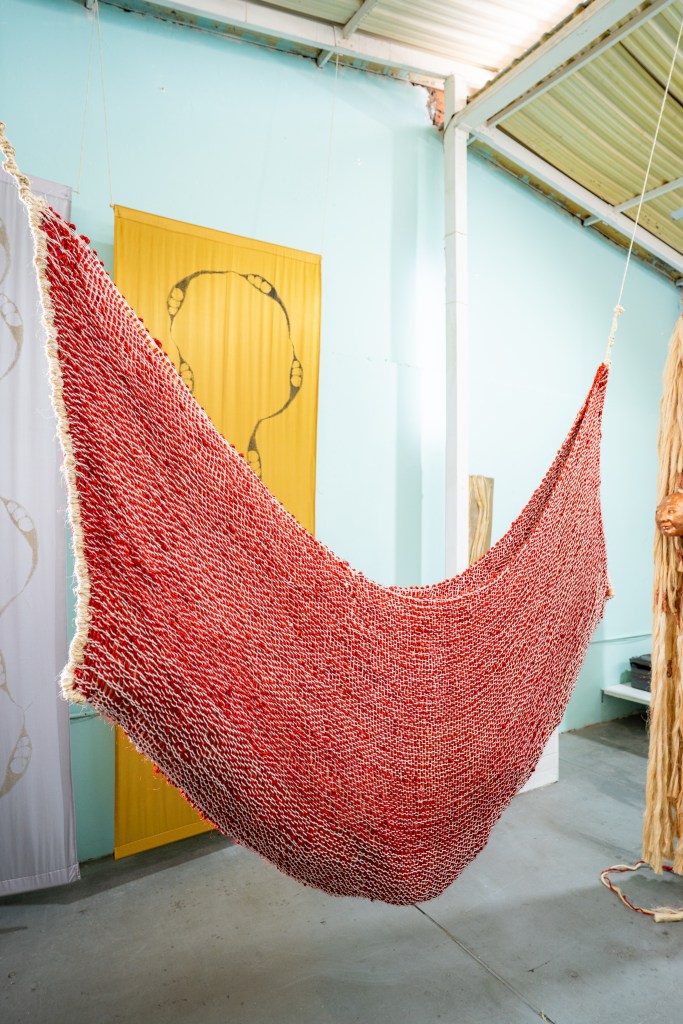


The Exodus exhibition presents a series of environmental sculptures. These are works with which for more than a decade Olga Mercedes Bautista has been experimenting. She offers a new approach towards Environmental Art incorporating organic materials to create works of large scale. Bautista believes that an object, extracted from its natural environment, can adapt, expand, and become a force within its surroundings, taking on a new identity while maintaining its own individuality. Its original plasticity will become a new artistic expression. Bautista, a Master of Fine Arts and Art Education, brings conceptual depth to the installation of environmental sculptures with Gestalt principles of visual perception; organizing and unifying visual elements into the whole concept rather than as divided parts. The contrast of combining different shades of reds with the fique tree material intent to symbolize the contamination of the rivers and the forestal destruction. The fragmented ecological system and disappearance of biodiversity is also as well another of Bautista grievances. The movements that have most influenced her work by embracing ecological change have been to list a few; the Land Art, the Art Povera, the Zero Art, the performance art, the social sculpture, The British Land Art and Environmental Art. Finally, it is important to express the necessity of initiating a dialog about how we construct nature instead of how nature constructs us. What nature considers in contemporary times of genetic alteration, residual management and desertification. It is necessary to fortify a sincere connection between the processes of nature and human life, culture, urbanization and industrialization as well as to promote projects that will unify culture and the environment.
La exposición Éxodos, presenta una serie de esculturas ambientales con obras que Olga Mercedes Bautista lleva más de una década experimentando. Ofrece un nuevo enfoque hacia el arte ambiental, incorporando materiales orgánicos para crear obras a gran escala. Bautista considera que un objeto, extraído de su entorno natural, puede adaptarse, expandirse y convertirse en una fuerza dentro de su entorno, apropiándose de una nueva identidad pero manteniendo su propia individualidad. Su plasticidad original se convertirá en una nueva expresión artística. Bautista, magister en Bellas Artes y en Education del Arte le aporta la profundidad conceptual a la instalación de las esculturas ambientales con teorías de vision perceptual de Gestalt principios organizando elementos visuales dentro de grupos que se unifican. Los tejidos fueron realizados en comunidad y colaboración de Hernán Pérez, tejedor y artesano del Carmen del Viboral. El contraste del uso del color rojo con el color natural del fique reflejan el símbolo de los ríos en destrucción y la ausencia o perdida forestal, sistema ecológico fragmentado y la desaparición de la biodiversidad. Los movimientos que más han influenciado su trabajo y que han acogido el cambio ecológico han sido el Land Art, el Arte Povera, el Zero Art, el performance art, la escultura social, el Land Art británico y el Environmental Art. Finalmente, es importante expresar la necesidad de iniciar un diálogo sobre cómo construimos la naturaleza, en lugar de cómo la naturaleza nos construye a nosotros. Lo que considera una naturaleza en tiempos contemporáneos de alteración genética, gestión de residuos y desertificación. Es necesario fortalecer una conexión sincera entre los procesos de la naturaleza y la vida humana, la cultura, la urbanización y la industrialización al igual que promover proyectos que vinculen la cultura y el medio ambiente.
 Olga Mercedes Bautista